Why your freight bill is higher than your quote
Reweighs, reclasses, and missed accessorials can land weeks after delivery. Here is why they happen, how to prevent them, and how to dispute one.
It happens more than you would think
You booked at one price, and the invoice came in higher. Weeks later. In LTL that is common. Reclass and reweigh adjustments typically add 10 to 20 percent on top of the booked rate, and they can account for 5 to 15 percent of what a shipper spends on LTL, according to freight provider Warp. The corrected bill often shows up two to six weeks after delivery, long after the freight is gone.
Almost every one of these traces back to three things: the weight, the class, or a service the carrier provided that was not on the bill of lading.
Reweigh: the weight was off
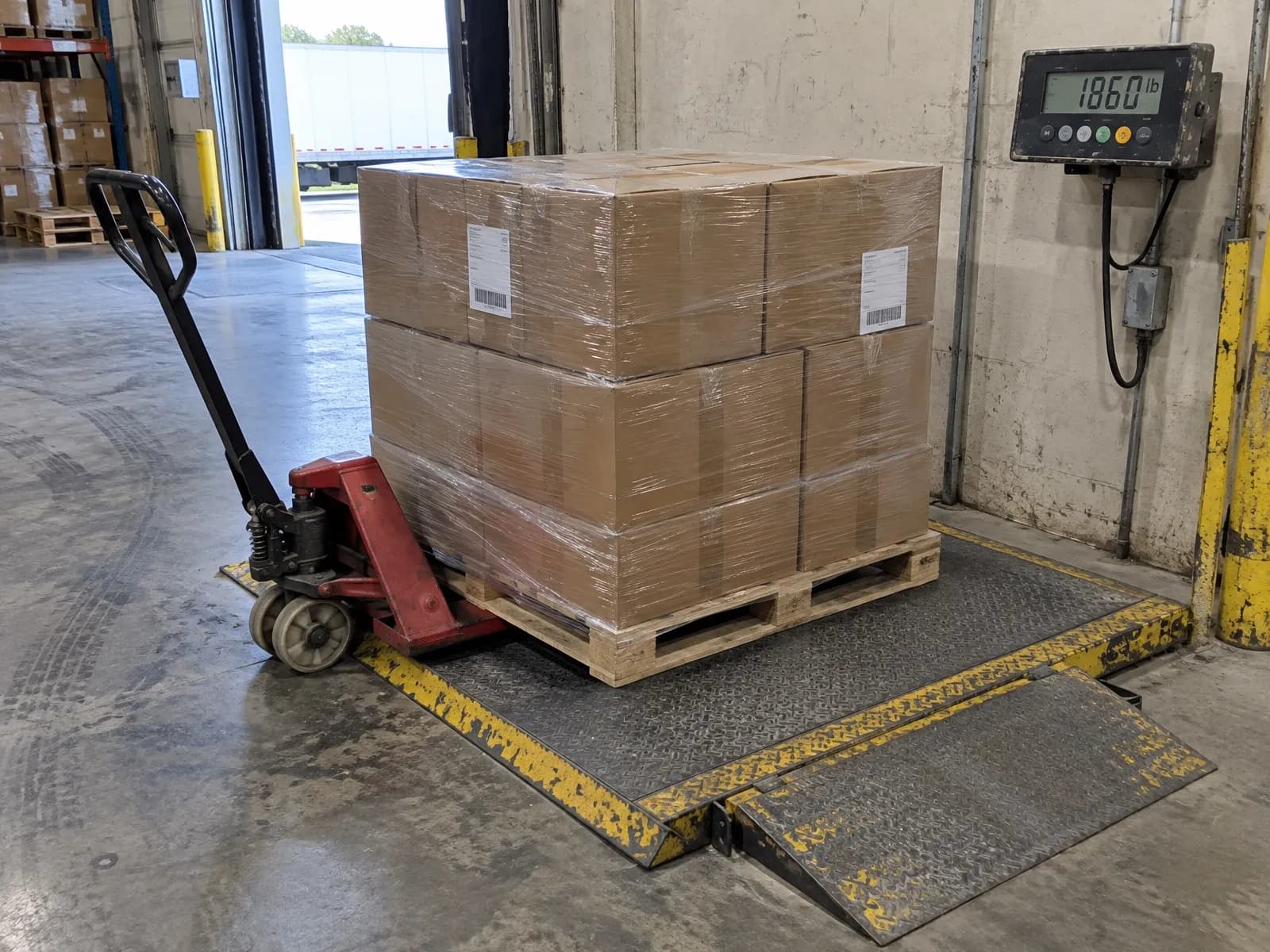
Carriers weigh freight on certified terminal scales as it moves through their network. If the scale reads heavier than your bill of lading, they re-bill at the new weight and may add an inspection fee, typically $50 to $150. Small differences are usually allowed. Warp cites a common tolerance of 200 lb or 5 percent, whichever is smaller, though each carrier sets its own rules.
The usual cause is an estimate. A forklift's dial gauge is not a certified scale, and the pallet itself can weigh 40 lb or more.
Reclass: the class was off
Many terminals measure freight with dimensioners, machines that scan length, width, and height. If the dimensions work out to a lower density than you declared, the shipment is reclassed to a higher class and the whole bill re-rates.
You enter the boxes: 48 × 40 × 48 in, 650 lb. That is 53.3 cubic feet, 12.18 lb per cubic foot, class 85.
The carrier measures it on the pallet: 48 × 40 × 60 in. That is 66.7 cubic feet, 9.75 lb per cubic foot, class 100.
Twelve inches of pallet and wrap moved the shipment two classes, and the entire linehaul is billed at the higher class.
Most reclasses come from dimensions that were declared too small. Our guide to freight class after the NMFC changes shows how to calculate density yourself.
Accessorials nobody declared
If the driver arrives and there is no loading dock, they use a liftgate. If the address turns out to be a home, it is billed as residential. Services left off the bill of lading are added after delivery, usually at the carrier's full rate, and they are hard to negotiate down. Correcting a bill of lading after pickup can carry its own fee.
How to prevent it
- Measure the way it ships. Pallet and wrap included. Round up to the next inch.
- Weigh on a real scale. Round up to the next pound. Do not estimate from a forklift gauge.
- Take a photo before pickup. One photo of the pallet with a tape measure showing the height, and one of the scale reading if you have it.
- Declare every service. No dock, a home address, a delivery appointment: put it on the quote and the bill of lading.
- Describe the freight accurately. A vague description invites an inspection.
How to dispute an adjustment
- Ask for the proof. Request the carrier's weight and inspection certificate, including the scale reading or dimensioner scan, and any photos.
- Compare it with yours. Line it up against your bill of lading, your measurements, and your pickup photos.
- Send your evidence in writing. Include the PRO number, what you declared, and your photos.
- Watch the deadline. Carriers set time limits for billing disputes, so act when the corrected invoice arrives, not when you get around to it.
On Anvil, every invoice is checked against what you booked. When a carrier bills more, we flag it, dispute it with your bill of lading and photos, and show you each step until it is resolved.